

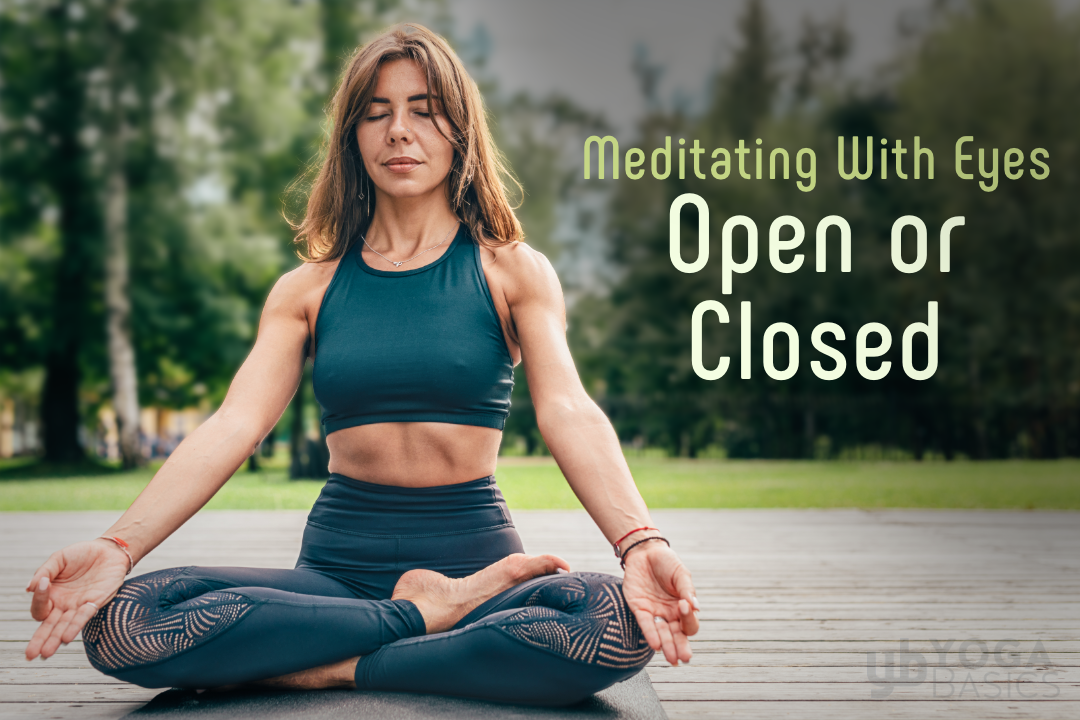
There is loads to determine when simply beginning meditation: What approach must you attempt, how lengthy must you sit, and how must you breathe? An neglected but essential query is “should I meditate with my eyes open or closed?” There’s no right reply—each strategies have their very own execs and cons. But how you employ your eyes has a huge impact in your meditation. Learning about the advantages and challenges of every might help you reply this query primarily based in your particular person wants, expertise, and objectives.
The Importance of the Eyes in Meditation
Where you place your gaze throughout meditation impacts your psychological focus, your degree of consciousness, and your potential to manage your feelings. When your eyes are closed, you restrict visible distractions, which may deepen your inner consciousness. With your eyes open, you should use a focus for cultivating dharana, or focus. Generally, I like to recommend eye-closed meditation for novices.
The Power of Drishti
The historical yogis found that the place our gaze is directed, our attention follows. They created a way of utilizing a selected focal or gazing level—referred to as drishti—to take care of a centered thoughts throughout yogic practices. Although practitioners typically use a drishti in open-eyed meditation, they’ll additionally use inner focus factors when their eyes are closed. Drishti is a foundational instrument to provide your wandering thoughts a easy, regular job—specializing in one spot—to cultivating dharana (focus).
The Spiritual Eye
There is one inner drishti that’s central to the yogic custom: the non secular eye. Also often called the third eye or Ajna chakra, it’s energetically positioned within the area between the eyebrows. Yogis think about it a gateway to deeper perception and consciousness. Focusing your attention right here shifts your consciousness away from the chattering ego thoughts. This additionally elevates consciousness and deepens non secular consciousness. Many meditators expertise it as an inside gentle and use it as a strong instrument to entry to the inside kingdom of the thoughts.
Vyutthana and Nirodha
In yogic philosophy, there are two ideas that describe the motion of consciousness within the thoughts: vyutthana and nirodha. Vyutthana is the outward power that pulls the thoughts away from its heart towards distractions. This power is pure and fairly fixed. Nirodha is the inward power that pulls the thoughts towards its supply and essence, resulting in a state of calmness and readability. This power arises throughout movement states however may also be consciously cultivated.
During meditation, the thoughts typically experiences durations of vyutthana, the place ideas come up and pull your attention outward. Closing the eyes can abate this outward power, making it simpler to remain internally centered. With an open-eye meditation, the outward pull of vyutthana is normally stronger. This is tougher, as one should train the thoughts to watch distractions with out changing into hooked up.
Advantages of Meditating with Eyes Closed
- Reduces exterior distractions: Closing your eyes helps you focus by eliminating visible distractions and exterior stimuli.
- Deepens inward focus and focus: Fewer distractions promote higher focus.
- Facilitates visualization and inner consciousness: Eyes-closed meditation helps you visualize and turn out to be extra conscious of your body’s sensations.
- Promotes rest and calmness: Shutting out the world might help decrease stress and induce a peaceable state.
Disadvantages of Meditating with Eyes Closed
- Possible drowsiness or falling asleep: If you’re drained, a scarcity of visible stimulation would possibly make you extra sleepy.
- Increased thoughts wandering: For some individuals, ideas are likely to drift extra and not using a visible anchor.
- Not appropriate for everybody: Beginners or people who find themselves liable to anxiousness might really feel disoriented or uneasy with their eyes closed.
Advantages of Meditating with Eyes Open
- Enhances alertness and present-moment consciousness: Keeping your eyes open helps you keep awake and attentive.
- Useful for mindfulness in each day life: Practicing meditating with open eyes helps you enhance your focus in on a regular basis actions the place you’ll be able to’t shut your eyes.
- Can cut back the tendency to go to sleep: Light stimulates the mind to really feel awake and energized.
Disadvantages of Meditating with Eyes Open
- Potential for distraction: External sights would possibly pull your attention away out of your inside focus.
- Harder to take care of deep inner focus: Visual stimuli can compete together with your chosen object of meditation.
- May require extra observe: More training and observe could also be essential to keep away from distraction and sensory overload.
- Eye pressure: A protracted, intense gaze can pressure and tire your eyes.
Choosing What’s Right for You
When deciding whether or not to meditate together with your eyes open or closed, think about these factors:
- Your surroundings: A quiet, protected area would possibly help an eyes-closed observe, whereas busy locations could also be higher suited to an eyes-open one.
- Your expertise degree: Beginners typically discover it simpler to shut their eyes to restrict distractions. Others want open-eye strategies to remain grounded.
- Your meditation objectives: If your purpose is deep rest, you would possibly lean towards closed eyes. If you’re cultivating alertness, an open-eyed observe could also be extra useful.
Try each approaches in several classes. Notice how every one feels, each bodily, energetically, and mentally. You could be stunned by which methodology finest resonates with you. You can even mix them—start together with your eyes closed and then open them towards the tip, or alternate primarily based on how you are feeling.
Meditation Techniques by Eye Position, Pros, and Cons
| Meditation Technique | Eye Position | Description | Benefits | Challenges |
|---|---|---|---|---|
| Guided Meditation | Closed | Listening to a instructor’s voice guiding your meditation. | Helps maintain the thoughts engaged. | May require an exterior audio supply. |
| Body Scan Meditation | Closed | Focusing on bodily sensations in several elements of the body. | Anchors attention to present second. | Buried feelings might floor, which may be unsettling or overwhelming. |
| Visualization Practices | Closed | Imagining calming scenes, optimistic photos, or vitality movement. | Enhances inner consciousness and creativity. | Requires creativeness and focus. |
| Breath Awareness | Open or Closed | Focusing on the feeling of the inhalation and exhalation. | Calms the thoughts and promotes rest. | Mind might wander and not using a clear anchor. |
| Blindfold Meditation | Closed | Using a light-weight barrier to cut back gentle however not totally shut eyes. | Reduces distractions whereas stopping drowsiness. | May be uncomfortable, requires eye masks. |
| Soft, Unfocused Gaze | Open | Relaxing the eyes and gazing gently downward or at a impartial spot with out sharp focus. | Maintains alertness with minimal distraction. | Requires observe to keep away from focusing too arduous. |
| Gazing at a Fixed Point (Trataka) | Open | Concentrating on a single level like a candle flame. | Builds intense focus. | Eye pressure is feasible if achieved too lengthy. |
| Mindful Observation | Open | Watching environment with out judgment, noticing colours, shapes, or actions. | Enhances present-moment consciousness. | External distractions might disrupt focus. |
| Zazen (Zen Meditation) | Open | Staring at a clean white wall | Develops calm alertness and detachment. | Requires self-discipline and observe. |
| Walking Meditation | Open | Moving slowly whereas paying attention to every step and breath. | Integrates mindfulness with motion. | Can be tougher to take care of focus in busy areas. |
Final Reflections
The historical yogis understood that the trail inward is exclusive for every and each person. One day, closing your eyes would possibly provide a sanctuary from the world, permitting you to dive deep into stillness. Another day, a tender, open gaze could be the right observe so that you can keep present and centered in your breath.
I encourage my college students to strategy their meditation observe with a way of journey, inquiry, and self-compassion. Experiment, keep curious, and honor your wants. Rules and rigidity may be useful to train the thoughts and create a routine. But profound insights typically come not from following a rule, however from listening to the instructor inside.















Discussion about this post